



· Yogesh Khedar· Industry· 3 min read
Will Drones Replace CCTV? Wrong Question
CCTV persists and never blinks. Drones move, verify and pursue. Security works best when the camera detects and the drone investigates.
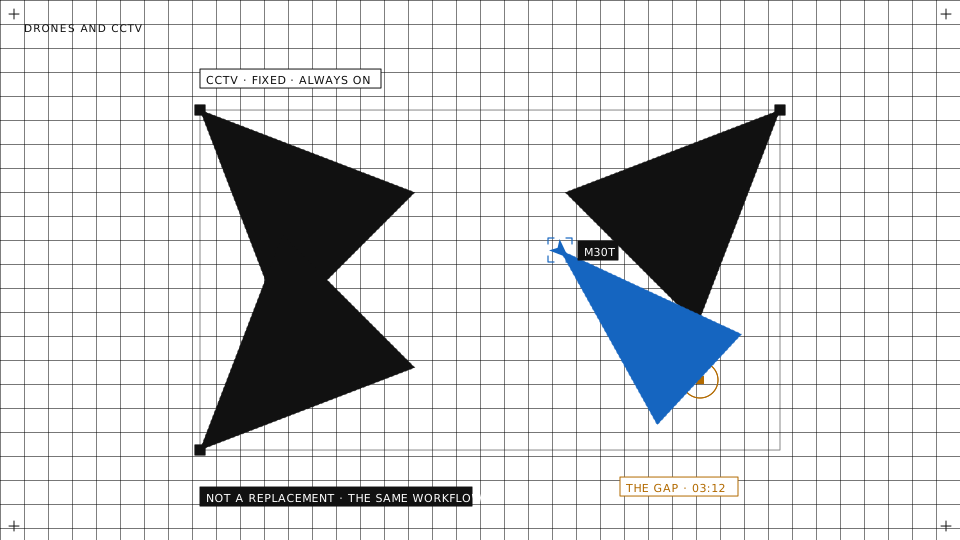
Ask a security manager whether drones will replace their cameras and you will get a polite no. Rightly so. But the interesting answer is what happens when the two work together, and what the software between them has to do.
What CCTV does well
Persistence. A fixed camera watches the same choke point every hour of every year at a marginal cost per hour no aircraft will ever match. It does not need a pilot, a battery or a weather check. For known critical points, the gate, the loading bay, the server room door, nothing beats it, and nothing will.
It also has the integration already. The cameras are in a video management system the security centre watches, with recording, alarms and the operators’ habits built around it.
What CCTV cannot do
Move. A fixed camera cannot follow a person across a site, look behind the building, change its angle, or cover the gap between two installations. Every site has blind spots, and intruders learn them faster than budgets close them.
It also cannot verify. A motion alarm at the fence at 03:00 is a fox, a plastic bag or a person, and the camera that raised it often cannot tell. Every one of those alarms costs a patrol trip or gets ignored, and both outcomes are expensive.
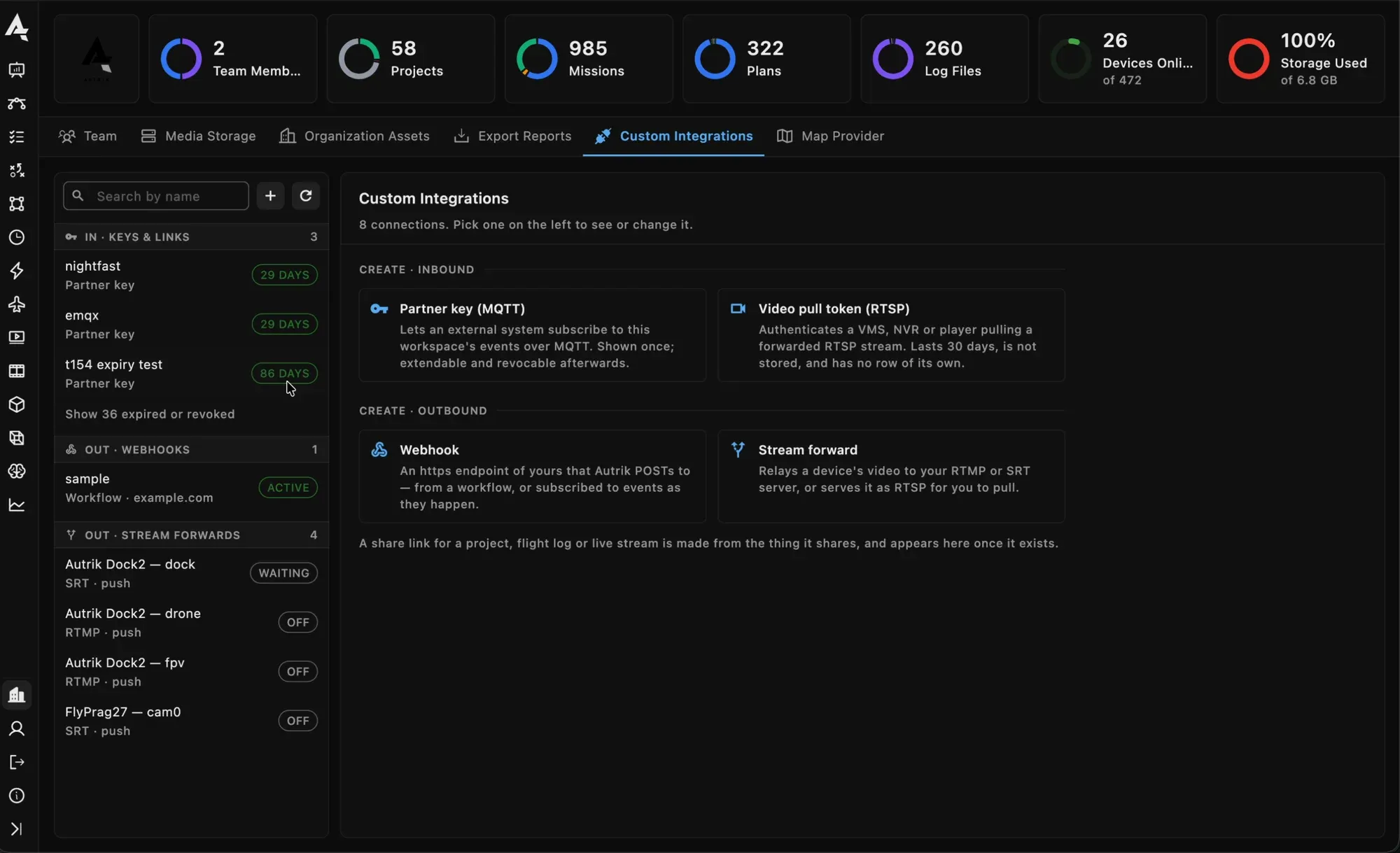
Custom integrations: stream forwards over RTMP and SRT, an RTSP pull token for the VMS, partner keys and webhooks.
The combined model
The model that works in practice is detection by the static layer, verification by the mobile one.
A camera, a fence sensor or an intrusion system raises an alarm. The alarm reaches the operations platform as a webhook. A workflow checks its conditions, weather, the aircraft’s readiness, the time window, and, where the SOP requires it, waits for an operator to approve the launch. The aircraft leaves its dock, flies to the alarm’s position at the altitude the plan allows, and puts a thermal and a zoom camera on it while the responders are still getting their boots on. The feed lands in the security centre as one more camera in the VMS, pulled over RTSP or pushed over RTMP, so nobody opens a new application at 03:00. The flight is recorded, the operator’s decision is logged, and the aircraft returns to charge.
That is the alarm-response workflow and the VMS integration in AutrikOS. The aircraft is a camera that goes where the alarm is.
Between alarms, the same aircraft flies patrols on a schedule, the perimeter at 22:00, 02:00 and 05:00, with the dock doing the launching and the landing.
What it takes to run
A dock at the site, an aircraft with the payload for the night, and an authorisation that allows the flights without a pilot standing there. On the software side, geozones that keep the aircraft inside the site and away from the neighbours, checklists that still apply to an automated launch, and the roles that say who may approve a flight and who may only watch.
So, replacement?
No. A force multiplier layered on top. The honest pitch is not fewer cameras; it is that every alarm gets investigated in seconds instead of minutes, false alarms stop costing patrol trips, and the gaps between cameras stop being gaps.
Running a site with more alarms than responders? Talk to us about drone-verified security, and see the security page for how it is set up.