Bandwidth
A detection is bytes; the video it came from is megabits per second. Deciding onboard is what makes the link budget work.




Sending every frame to the cloud to ask whether anything is in it wastes the one resource a flying robot never has enough of. Edge AI puts the model on the aircraft and sends the answer instead.
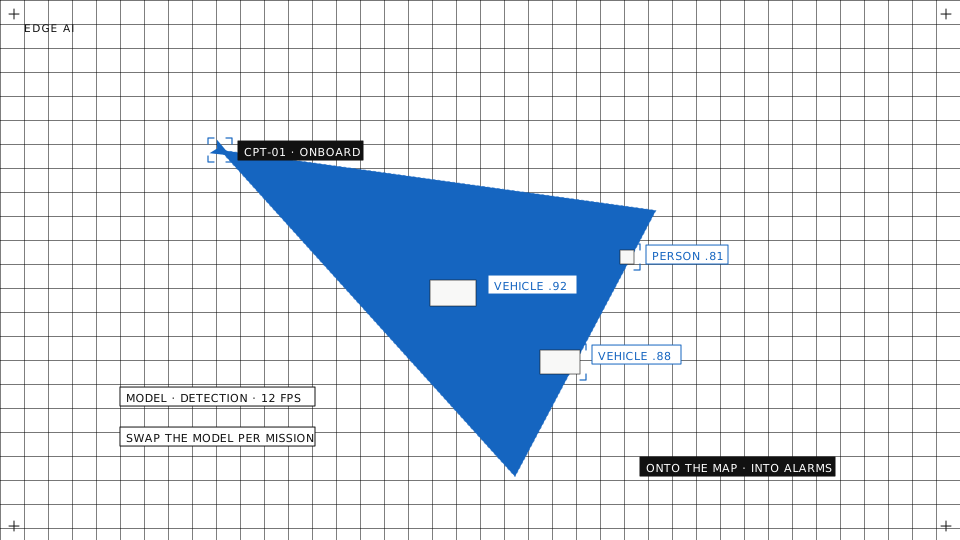
A detection is bytes; the video it came from is megabits per second. Deciding onboard is what makes the link budget work.
When a detection should change what the aircraft does next, a cloud round trip is too slow to be part of the loop.
Imagery that never leaves the vehicle cannot leak in transit — which matters where the footage covers people or protected sites.
Simulation · a thermal hand-off from a car to a fire truck in CARLA, detections boxed, visible and simulated 640×512 thermal side by side
An inference nobody acts on is an expensive way to heat a circuit board.
Detections appear on the shared operational map as they happen, visible to everyone watching the mission.
A detection can raise an alarm, and an alarm can dispatch an aircraft — the loop closes without an operator relaying it.
Findings carry into the mission report with their position and timestamp, so the deliverable assembles itself.
Today the models run on the platform: an AI pipeline takes a live stream from any aircraft or camera, runs the model and puts the detections back on the video wall; the DJI Dock 3's on-board recognition is driven from the same console.
Interchangeable models on the aircraft's own compute, with the OAK-D Lite as the reference device, are in development on the Skyclient side. Detections into alarms and reports follow.
Tell us what you need to find and we will talk through what runs onboard today.