For Manufacturers

The bug you cannot reproduce is in your logs

Building an aircraft means chasing intermittent faults across scattered logs, on a schedule. The data that explains most of them was already recorded — it just was not somewhere anyone could ask questions of it.

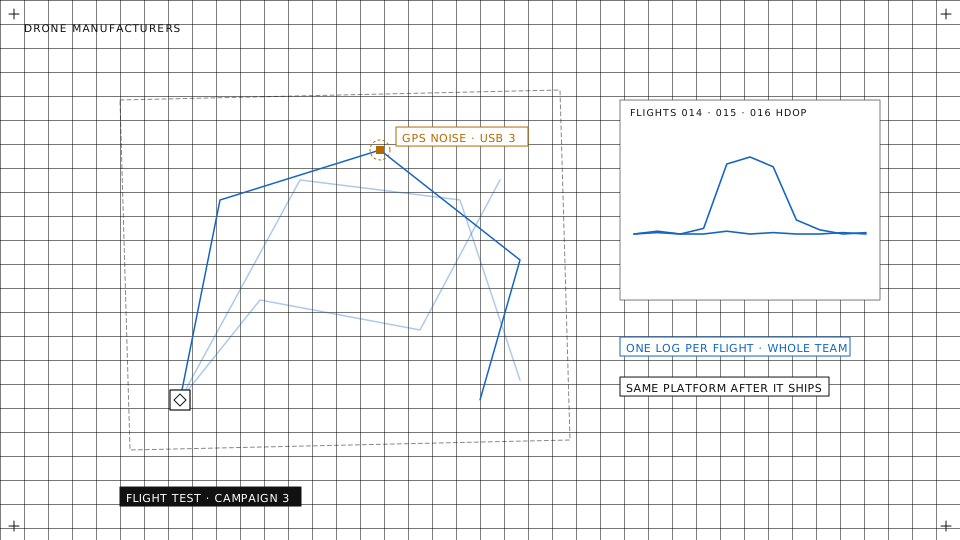
Plan map: three test flights over a range, one flagged for GPS noise, with the chart beside it
Flight test

What actually goes wrong, from experience

The interference bug that cost three weeks

GPS accuracy that degrades only when a particular subsystem is active is the classic example: intermittent, hardware-dependent, and invisible in any single flight log.
  • GPS and USB interferenceA well-known and still frequently rediscovered failure mode. Moving affected subsystems to Ethernet removes the coupling entirely.
  • CAN with telemetryWhere Ethernet is not practical, CAN-based subsystems that report their own state let you see the fault instead of inferring it.
  • Design follows requirementsMultirotor, VTOL quadplane, fixed-wing STOL — the airframe follows the mission, and the instrumentation should follow the airframe.
The interference bug
GPS RECEIVERSUBSYSTEMFLIGHT CONTROLLERUSBcouplingstate reportedGPS ACCURACY · ONE FLIGHT LOGtime →subsystem activeno dropSUBSYSTEM STATE · IN THE LOG
GPS accuracy drops now and then. Intermittent and hardware-dependent: the cause is invisible in any single flight log.
Instrumentation

Log more than you think you need

Storage is cheap. Reproducing a fault six months later is not.

Over-instrument during development

The data you did not capture is the data the intermittent fault needed. During development, capture generously.


Share it across the team

Logs that live on the test engineer's laptop help one person. Logs in one place help everyone who touches the aircraft.

More data, faster iteration

The rate at which you can answer questions about the aircraft sets the rate at which you can improve it.

Device · parameters and their change history: who changed what, when

Today vs. tomorrow

How analysis is done now, and what it costs

Desktop tools, one flight at a time

The industry standard is a desktop log viewer, opened per flight, by one engineer. It works — for one flight. It cannot answer anything about the campaign.
  • Centralised loggingEvery test flight lands in the same place automatically, so the archive builds itself rather than depending on discipline.
  • Time-series across campaignsCompare this week's builds against last month's, and see the trend that no individual flight review would reveal.
  • Planning and ops for developmentCloud-based flight planning and operations management for the test fleet, so campaign coordination stops being a spreadsheet.
Campaign analysis
ONE ARCHIVELOGLOGLOGLOGLOGLOGDESKTOP LOG VIEWER1 flight · 1 engineerTEST FLIGHTautomaticALL FLIGHTS · ACROSS CAMPAIGNSLAST MONTHTHIS WEEKTREND
The industry standard: a desktop log viewer, opened per flight, by one engineer. It works, for one flight.
After the sale

Your aircraft has a life after it ships

Warranty backed by data

When the fleet reports what actually happened, warranty questions are settled by evidence instead of by argument.

Field failure modes

What breaks at customer sites is the input your next design revision needs most, and the hardest to collect.

Software your customers use

Ship an operations platform with the aircraft rather than leaving each customer to assemble one.

Simulation · the same onboard client on four robots, each on its vendor’s interface

Pilot programme for manufacturers

We work with OEM teams during development, not just after launch. Tell us what you are building.