Security-centre events
Alarms raised in your VMS or security centre can dispatch an aircraft as part of the existing response workflow.




The gap between an alarm firing and someone having eyes on the location is where most of the cost sits — in false dispatches, in delay, in uncertainty. Automated go-to-point closes it.
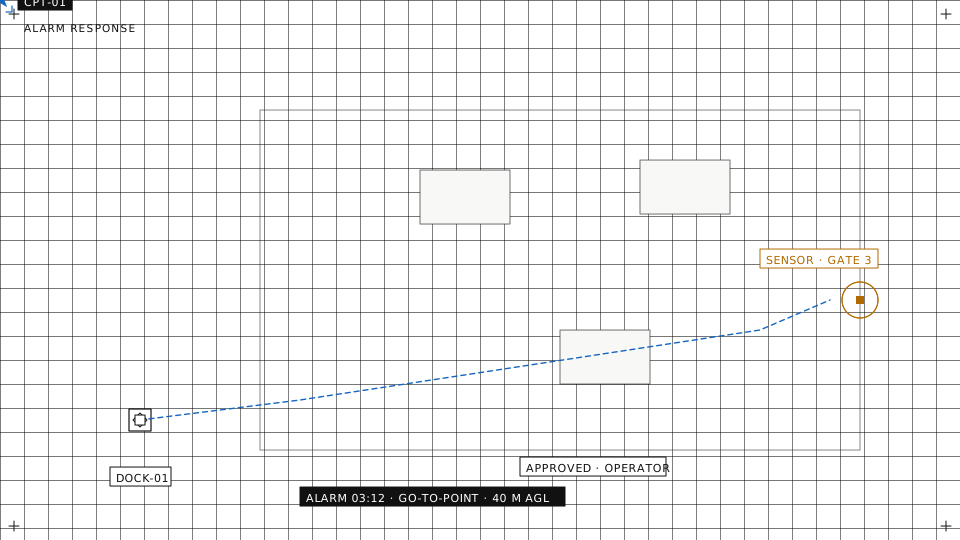
Alarms raised in your VMS or security centre can dispatch an aircraft as part of the existing response workflow.
Perimeter sensors, gas and environmental monitors, and other field devices can raise the same kind of trigger.
An operator can send the aircraft to a map coordinate directly, using exactly the same mission path.
An aircraft that launches itself needs tighter boundaries, not looser ones.
Automated missions fly only inside geometry cleared in advance — the approval happens before the alarm, not during it.
Choose per trigger whether the aircraft launches automatically or waits for an operator to confirm.
Automated launches run the same enforced pre-flight checks as any other mission.
Today an alarm reaches AutrikOS as a webhook or a sensor value that triggers a workflow. The workflow can wait for an operator to approve the run before the aircraft leaves; the flight then runs the plan and the limits it was given, inside the workspace's geozones, with the checklist the launch requires.
Distinct confirmation levels per alarm class and a separate catalogue of pre-approved flight zones are not built: approval is one step, and the geozones are the ones every flight uses.
Alarm response assumes an aircraft that is ready around the clock. Let us talk about your site.