LTE and 5G
Wide coverage and workable latency wherever there is a network, with a dependency on someone else's infrastructure.




There is no best way to talk to an aircraft — only the right one for your range, latency, bandwidth and spectrum situation. What should never vary is whether the link is protected.
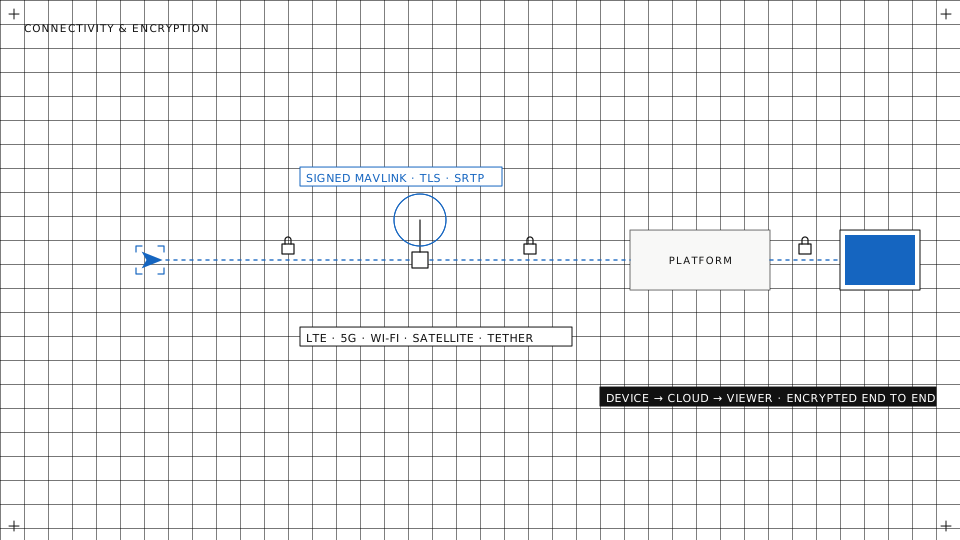
Range, latency, bandwidth, cost and spectrum licensing pull in different directions.
Wide coverage and workable latency wherever there is a network, with a dependency on someone else's infrastructure.
High bandwidth at short range with no per-flight cost — the natural choice for site-local and indoor operations.
Long range and independence from public networks, at the price of spectrum licensing and considerably more engineering.
Coverage where nothing else reaches, traded against latency, bandwidth and cost per megabyte.
The most reliable link there is, for persistent-stare operations where the aircraft does not need to travel.
Serious operations rarely rely on a single path — the interesting design question is what happens when the primary link degrades.
A link is only as protected as its weakest segment. The path from the aircraft to the operator normally crosses at least three: the air link, the connection into the platform, and the delivery to whoever is watching in a browser. Securing one and assuming the rest is the most common gap we see.
Data residency is part of the same question. Where the traffic terminates decides which jurisdiction it sits in, which is why deployment location is treated as a security decision rather than an operational convenience.
Tell us how your aircraft connect today and we will walk through the exposure with you.