



· Yogesh Khedar· Industry· 3 min read
Hardware Is Hard — Really?
Assembling a drone has never been easier. What is actually hard moved up the stack — reliability at scale, support, and the operations around the hardware.
“Hardware is hard” is the industry’s favourite sympathy card. Capital intensity, slow iteration, atoms against bits: the cliché has honest roots. It is also, today, mostly aimed at the wrong target.
Assembling hardware got easy
A competent team can put together a flying, sensing, communicating aircraft from commercial building blocks in weeks. An autopilot with a decade of open-source flight code behind it. Motors and ESCs that report their own rpm and temperature. Cameras, lidars and modems with published interfaces. A companion computer the size of a credit card that runs a full operating system.
The existence of so many drone hardware companies is itself the evidence. If building an airframe were the hard part, there would not be hundreds of teams doing it.
What is actually hard
Everything after the demo.
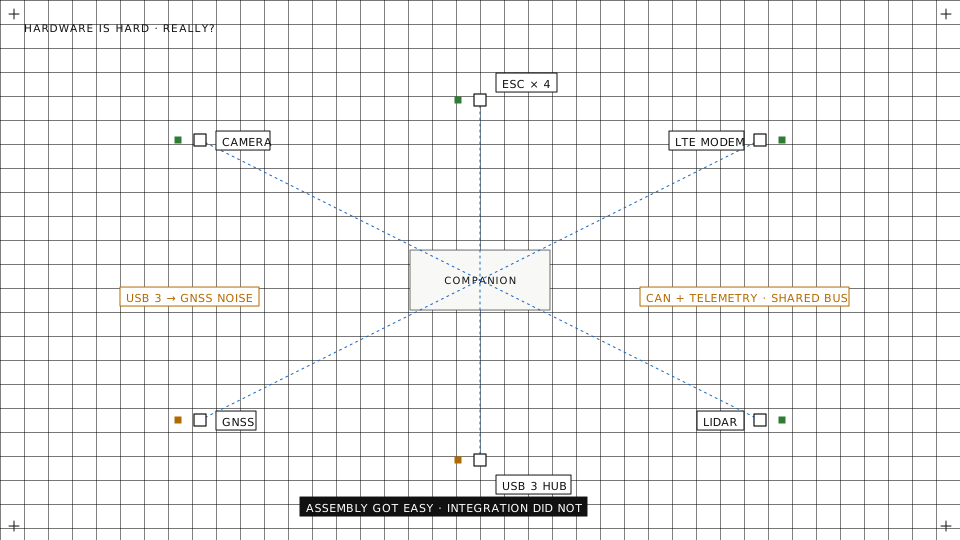
Integration. The parts work; the combination does not. A USB 3 hub placed next to the GNSS receiver wipes out the satellites, and the aircraft flies beautifully on the bench and loses position on the first windy day. The CAN bus shared between the ESCs and the telemetry radio drops packets exactly when both are busy. These are the war stories every manufacturer tells, and they are integration, not assembly.
Reliability at scale. The hundredth aircraft flying its thousandth hour, not the prototype flying its first. The motor that wears out at 300 hours, the pack that sags after 250 cycles, the modem firmware that leaks memory over a week of uptime. None of these shows in a demo and all of them show in a fleet.
Support and logistics. Spares, repairs, firmware across a fleet in three countries, diagnostics from a desk when the aircraft is on a site four hours away.
Evidence. Certification, compliance records, the audit that asks for the maintenance history of a specific battery pack.
Operations. The software, the data and the process that turn a machine into a dependable service. The teams that struggle are rarely struggling with the aircraft; they are struggling with the operation around it.
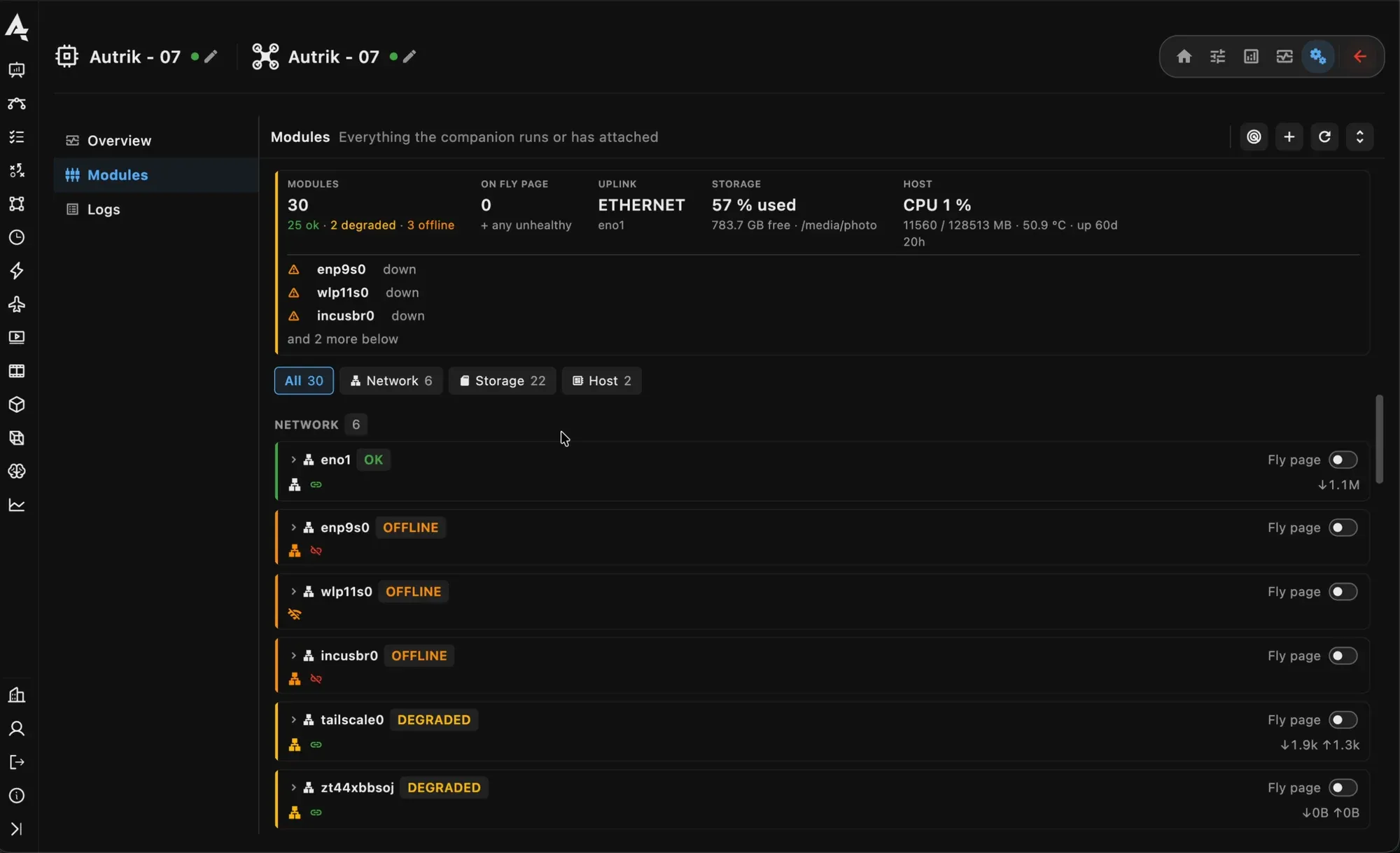
The modules on a companion computer with their state: OK, offline, degraded.
What the operation around the hardware looks like
It looks like software. An onboard client that discovers every peripheral, budgets the link between the video and the lidar and the log upload, and reports each module’s state so the modem that is degraded shows up as degraded, not as “the link was bad today”. A fleet page that shows every device, its firmware and when it was last seen. A health twin that reduces every flight’s log to per-component figures and says which motor needs a look before it fails. A parameter history that records who changed what, so the aircraft that flies differently since Tuesday can be explained.
That is what Skyclient and the fleet tooling in AutrikOS are, and it is where the hardness of hardware has moved.
Hardness moved up the stack
That is the honest reading of the cliché in 2026: hardware is easy to start and hard to sustain, and the sustaining part is software-shaped. Which is exactly where we build. AutrikOS is the operational layer that makes hardware companies and operators sustainable: the unglamorous hard part, productised.
Disagree? Good: tell us why. The space-grade version of this argument is in Drones Are Not Rocket Science.