



· Yogesh Khedar· Company· 3 min read
Why We Received Almost €500k in Public Funding
Competitive public programmes vetted the technology, the team and the plan — and funded the building blocks for autonomous robot operations.
Over the past years Autrik has been awarded almost €500,000 in public funding from competitive programmes: federal research funding, state-level innovation support and EU co-financed projects, the same programmes and partners listed on our homepage and project pages. This is the story of why, and of what it paid for.
What convinced the reviewers
Not a pitch deck; a thesis. Robot operations is becoming infrastructure, and the building blocks for it, fleet operations, onboard software, data pipelines, health monitoring, are being rebuilt from scratch inside every company that needs them. Our mission is to build those blocks once, properly, so that the people who make aircraft and the people who fly them do not each have to.
Add a team with aerospace discipline, a shipping product with real operations behind it, and partners who put their names on the consortium, and the case made itself in front of technical review panels more than once.
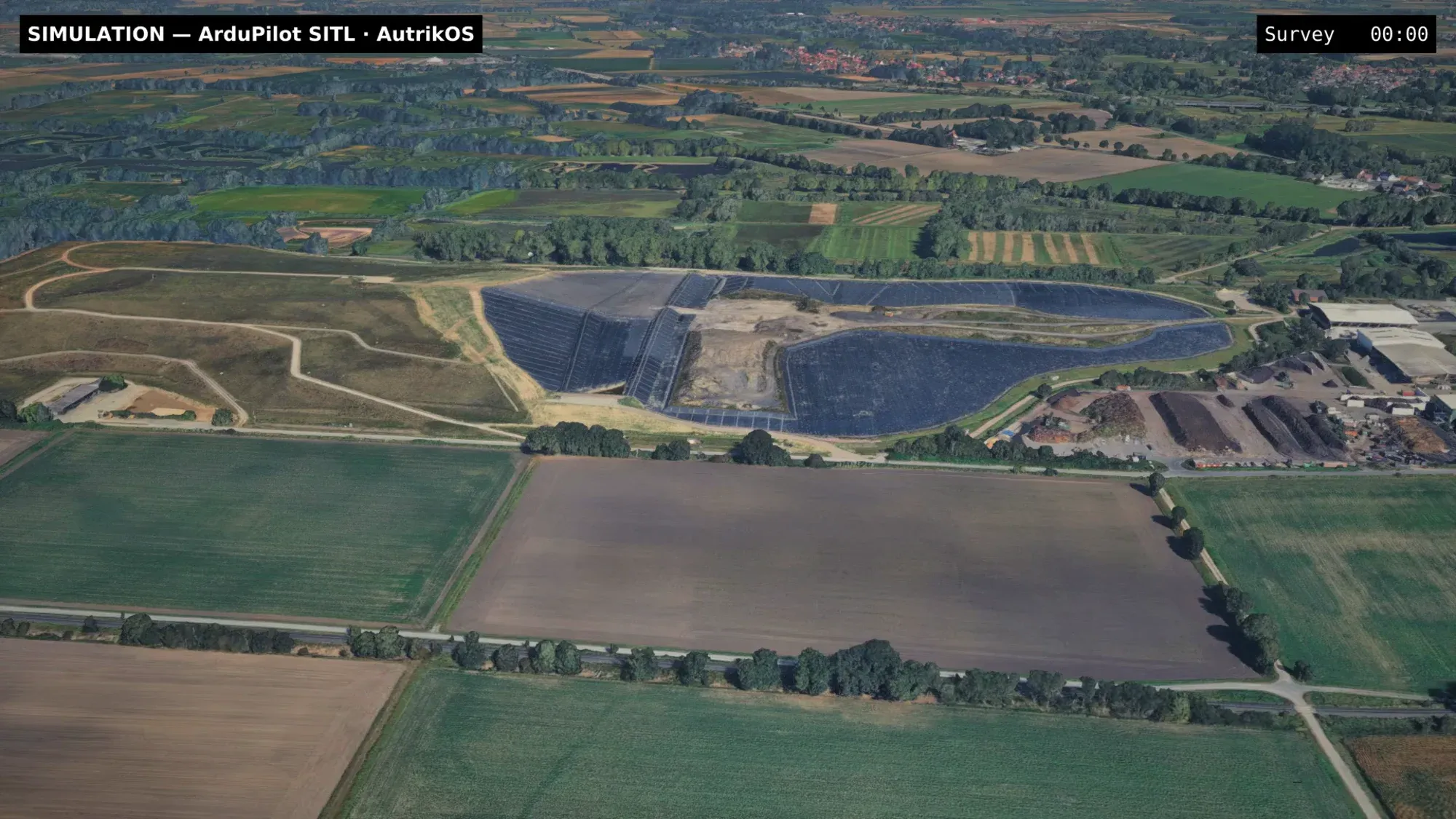
The photorealistic twin over farmland: one of the simulated worlds the funding built.
What the money built
Public funding at Autrik pays for the roadmap items that are important and slow, the ones a customer would not fund a quarter at a time. Revenue pays for the rest. Concretely:
- The multimodal work. Aircraft, rovers and boats on one console, with the onboard client running on each, the tuning page for the ground and water loops, and the harbour and landfill operations that proved the combination.
- The methane survey. A laser spectrometer and a thermal camera on a DJI aircraft, flown as a planned survey over a landfill, with the plume mapped on the project and the methane track drawn on the fly page. A consortium project with a research partner, now a feature.
- The health digital twin. Every flight’s log reduced to per-component health, judged nightly against baselines and published limits, with due dates and a tech log. Research first, product now.
- Simulated worlds. The photorealistic twin in Unreal, the physics bench in Gazebo, simulated docks and aircraft in the console, for rehearsal, training and training data.
- The hardening that turns features into infrastructure: the release train, the test suites against the real services, the offline build, the security posture an auditor can check.
Why it matters to customers
Every grant was competitively reviewed by people whose job is to find weaknesses in technology and teams. Winning repeatedly is external validation we could not buy.
More practically, it is why the research frontier does not come out of the product budget. The customer who pays for the console is not paying for the autonomy experiment; the grant is. And combined with being bootstrapped, it means the company is built for longevity rather than for a funding cycle: no round to close, no pivot to survive.
What it does not mean
Public funding is not revenue, and it is not a plan. The projects have scopes, partners and end dates, and a feature that only exists because a work package said so is a feature nobody runs. Everything above shipped because a customer flew it, and the grant made the first version affordable.
The philosophy behind the combination is its own post: Bootstrapped, and Backed by Public Funding.