Fleet Health

Availability should be a number, not a guess

On most fleets, "is it fit to fly?" is answered from a pilot's memory. The evidence to answer it properly already exists — every subsystem emits it on every flight, and it is thrown away on landing. Fleet Health keeps it, ranks it and trends it.

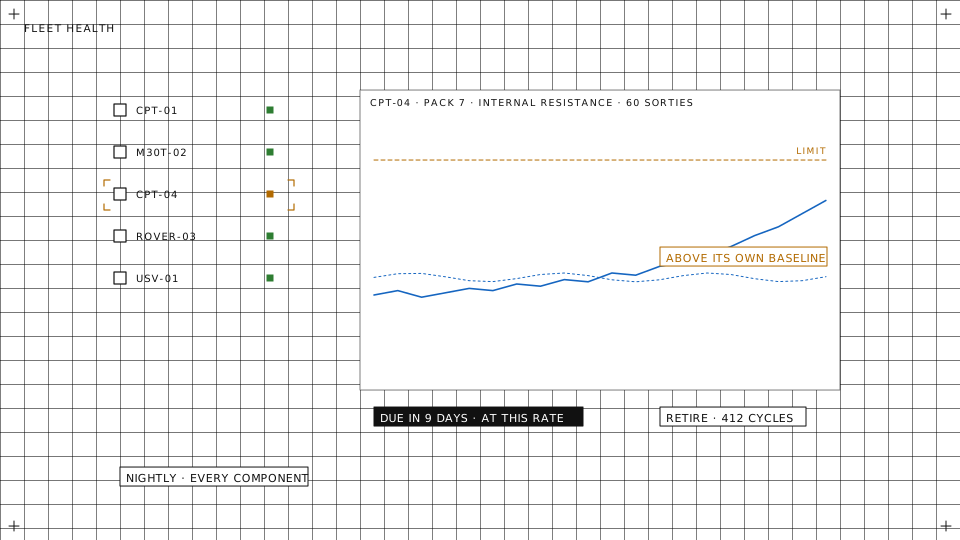
Plan map: a device list with one pack flagged, and its internal-resistance trend heading for the limit
The problem

Maintenance by calendar, grounding by surprise

Nobody is watching the slope

Components rarely fail without warning. They degrade — a little more current, a little more sag, a little more noise each week. A single flight cannot show a slope, so the warning goes unread and the failure looks sudden.
  • Fit-to-fly is folkloreThe aircraft that "has been a bit funny lately" is a fact living in one person's head. It should be a state on a board.
  • Warnings without a memoryEvery subsystem already reports its own faults. Unranked and discarded after each flight, they never add up to a trend.
  • Servicing on the wrong clockCalendar-based maintenance services healthy hardware and misses the unit that needed attention two hundred flights ago.
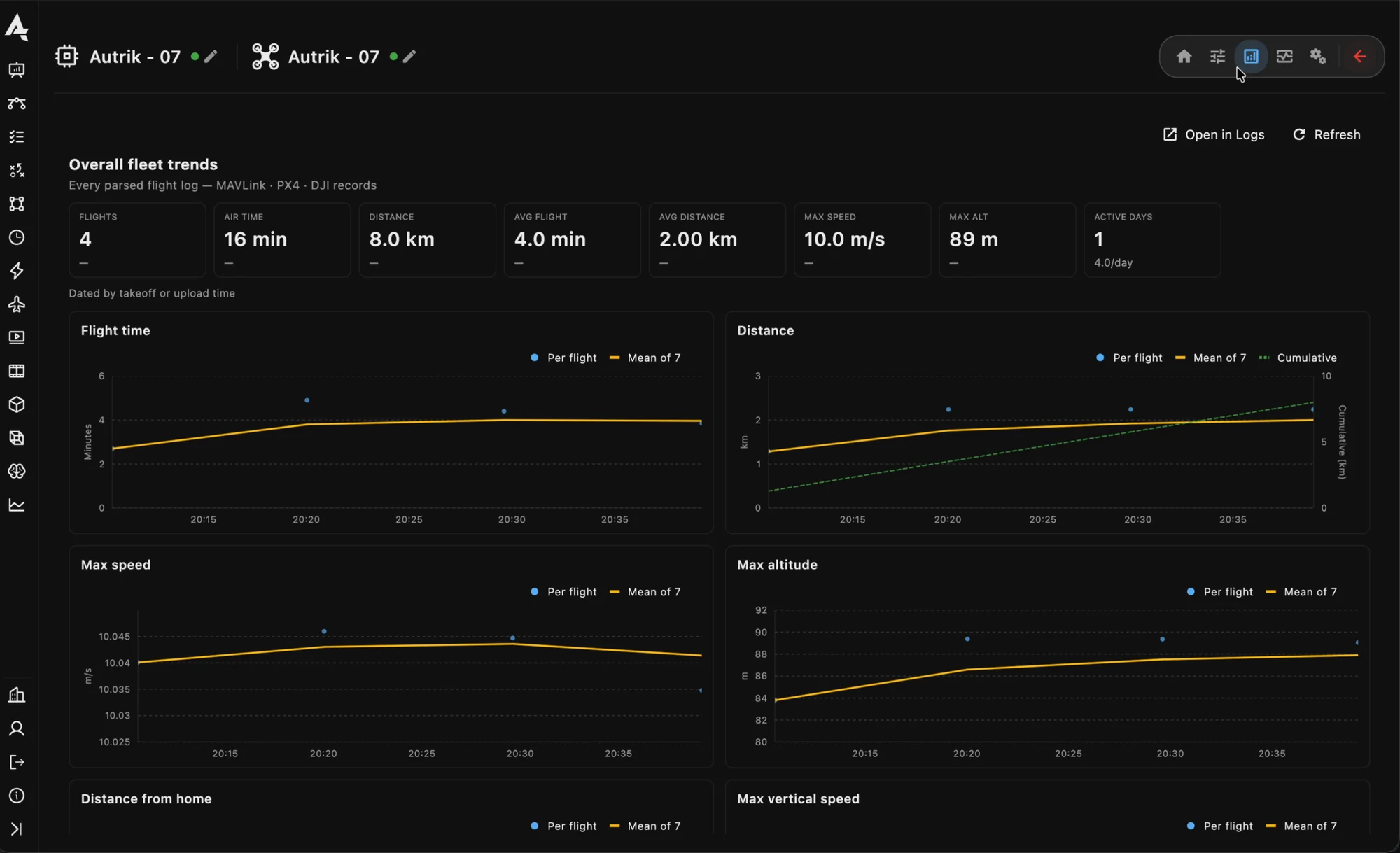
Flight logs, Trends for one device: flight time, distance, speed, altitude, battery and activity over the last flights
Battery health

The component that ages fastest, and warns you first

Lithium packs drive both the running cost and most of the unplanned downtime in a drone fleet — and they degrade in ways that are measurable long before they are noticeable.

Capacity and cycles

Usable energy tracked per pack over its life, against the cycle count and the calendar — both of which age a battery.


Sag under load

How far the pack drops at the takeoff step and in flight, and the internal resistance read from it. Rising resistance shows here well before capacity fade does.

Cell balance

Spread between cells across the discharge, where per-cell data is available — the difference between a pack to balance and a pack to retire.

Thermal exposure

Pack temperature during flight and, for a docked aircraft, while it charges. What a pack sits through between flights damages it as much as flying does.

Health follows the serial

Packs move between airframes. Their history moves with them, so a tired battery cannot hide in a different aircraft.

Retirement rules set in advance

Set the cycle limit and the cell-deviation limit once, away from the flight line. A pack over its limit, one that reports end of life, or one flown after retirement raises a finding; an admin retires or reinstates it in the register.

Subsystem health

Every subsystem of every device, in one state

Nominal, watch, act

A health board is only useful if it can be read in five seconds. Each subsystem resolves to a state you can act on, with the numbers underneath for the person who needs them.
  • NavigationAutopilot and estimator, IMU, compass, barometer, GNSS and RTK — scored on whether the estimator still trusts them, not on raw readings.
  • PropulsionVibration, and per motor the output, rpm and current spread in hover and the current per rpm — the signals that precede a bearing or a prop.
  • Link, companion and dockRadio link quality and errors, the flight controller's supply and load, the companion computer's CPU, memory and temperature, and the dock's own state — each kept apart from the aircraft rather than conflated with it.
Events & warnings

Faults that accumulate instead of evaporating

Ranked by severity

A hundred advisories and one real problem are not the same thing. Severity is the first sort, not a colour on a chart.

Deduplicated across flights

The same recurring warning is one issue with a frequency, not forty entries competing for attention.

In context

A warning opens the flight it came from, replayed with the telemetry around it, so "during the climb, over that building" is answerable. It stays open until an admin resolves it.

Baselines

The best reference for a component is its own history

Comparison beats thresholds

Absolute limits are hard to set and easy to argue with. A component compared against its own history, with the maker's limits where they exist, needs no agreed threshold to look wrong. Every night the fleet is re-judged, trends are fitted and a due date is put on each one heading for a limit.
  • Against itselfEach component against its own rolling baseline — the slope that says something changed, even while every value is still inside limits.
  • Against known limitsWhere the autopilot's maker publishes a limit — vibration, estimator trust, supply ripple, cell spread — it judges first, and the limit line is drawn on the chart.
  • Into maintenanceFrom a health state to a due list, a maintenance record and a tech log as a PDF, with the evidence attached — which also happens to be what a warranty claim needs.
In development

Against the fleet

The next baseline is the fleet: one aircraft against its siblings flying the same missions, one hardware batch against another. The health record already carries the scope for it; today the nightly job computes each component's own baseline and applies the published limits. Work orders and parts ordering are not in the product.

Send us a fleet's logs

We will show you the health picture already sitting in the data you are currently discarding.