



· Yogesh Khedar· Company· 3 min read
From Rocket Science to Drone Tech
What building for space teaches you, what transfers to drones, what you have to unlearn — and how the industry changed underneath the journey.
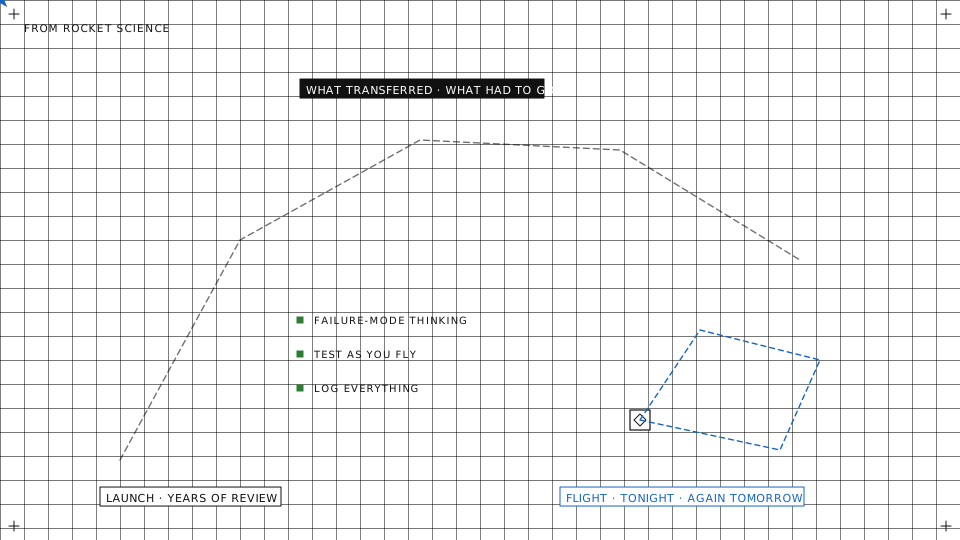
Before drones, there was space: years at ISRO, building for machines that get exactly one attempt. This post is about what that background gave us, what it could not, and how the drone industry changed underneath the journey.
What space teaches
Discipline as a survival trait. When there is no second attempt, review culture, test culture and failure analysis stop being process overhead and become the product. Every subsystem can end the mission, so systems thinking is not a skill, it is the job.
It also teaches humility about testing. A launch vehicle is never tested end to end before it flies. Every test is partial, every model is wrong somewhere, and the art is knowing which partial tests, combined, give you the right to launch. That habit of asking “what have we actually proven” never leaves you.
Why drones
Drones are accessible aerospace. The same physics and the same systems problems, but you can build one on a desk, fly it tomorrow, crash it, learn, and fly again next week. For an engineer raised on one-shot missions, iteration at that speed is intoxicating.
And the impact is immediate. A bridge inspected, a person found, a landfill’s methane mapped, a site surveyed: this week, by a machine you can carry. Space changes the world on a decade’s timescale. A drone fleet changes a utility’s maintenance plan this quarter.
What transferred, what had to go
The failure-analysis culture transferred directly and became a company habit: every anomaly gets a number, a root cause and a change. The systems view transferred: the aircraft, its link, its companion computer, the cloud and the operator are one system, and the failure is always at a boundary. The test discipline transferred, with a difference: here we can test the real thing, so we do, every night, on simulated fleets and real ones.
What had to be unlearned was one-shot perfectionism. A drone programme that polishes one aircraft to space grade has missed the point. The power of drones is a thousand imperfect flights with a learning loop: fleet thinking, not vehicle thinking. Reviews that took a month have to take an afternoon. Documentation that was a binder has to be a log the software writes by itself.
The industry moved too
When this journey started, building the aircraft was the achievement. A team that could make a multirotor hover reliably had a company. Hardware has since commoditised: open autopilots, motors that report their own health, cameras with published interfaces. The frontier moved up the stack, into software, operations and data: who can run fifty aircraft, not who can build one.
Which is exactly where we chose to build. The building blocks every robot operation needs, the onboard client, the fleet console, the data pipeline, the health twin, so that the people who build aircraft and the people who fly them do not each have to rebuild the operation from scratch.
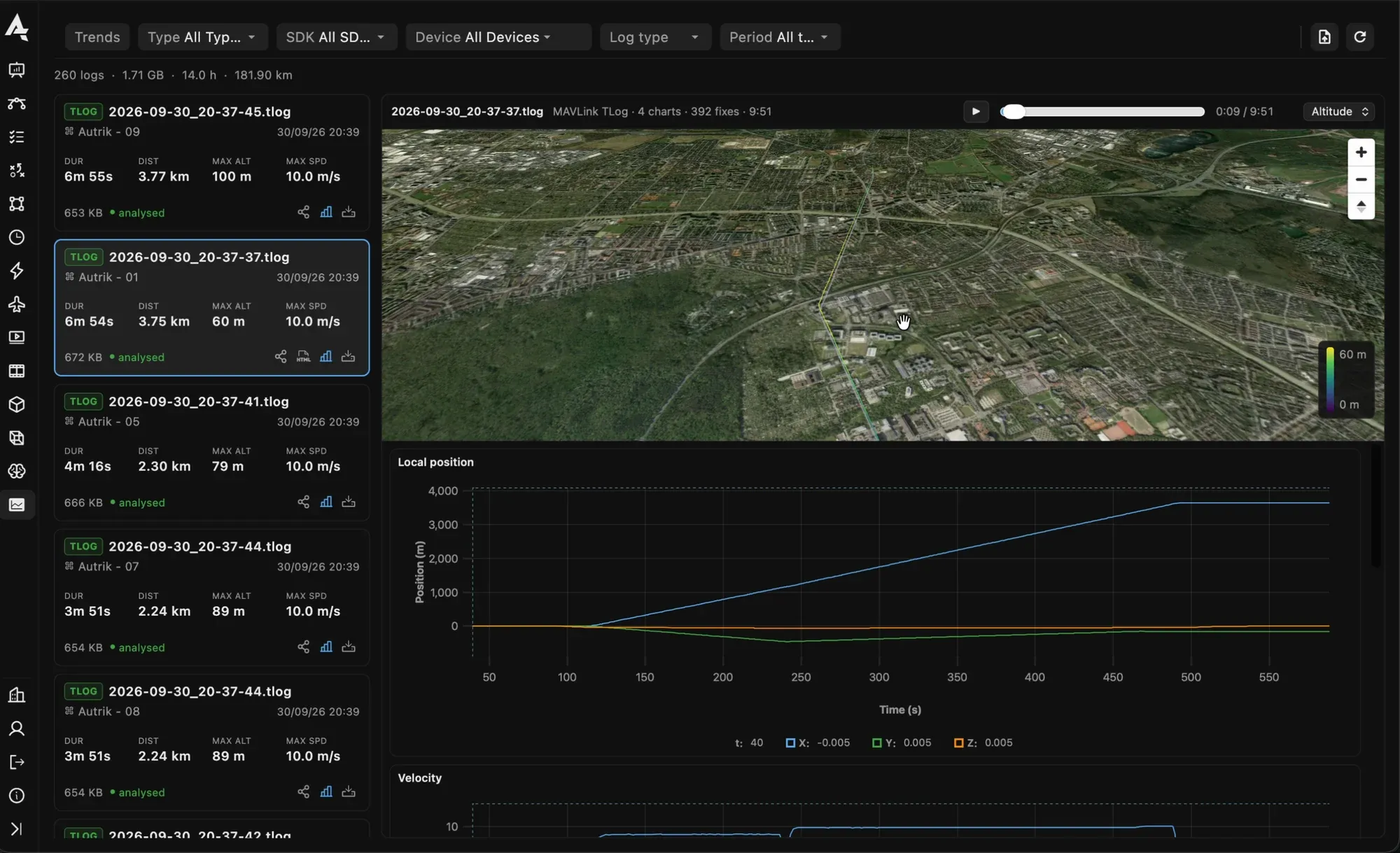
A flight log in the browser: the 3D track and the position chart.
What space would envy
One thing, mostly: the data. A space programme would give a great deal for a thousand flights’ worth of telemetry from the real vehicle. A drone fleet produces it every month and usually discards it. Keeping it, and reading it the way a failure-analysis board would, is the piece of space culture that drones can afford and space never could.
The drones-versus-rockets comparison deserves its own post, and it got one: Drones Are Not Rocket Science, But They Are Still Hard.