



· Yogesh Khedar· Industry· 3 min read
What It Really Takes to Secure Airspace from Drone Threats
Counter-UAS is sold as a box you buy. In practice it is layered detection, legally-constrained response, and integration into one operational picture.
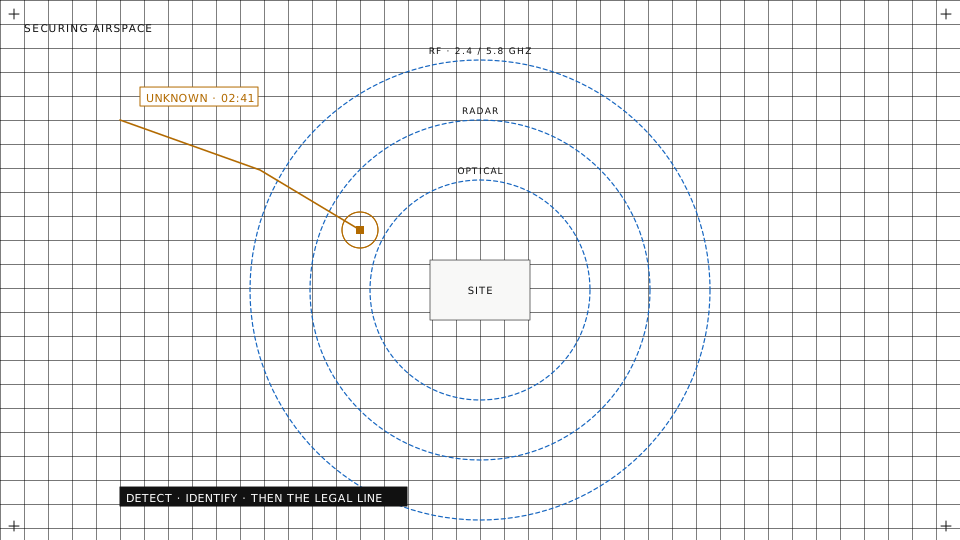
Counter-UAS is marketed as a box: buy the detector, problem solved. Teams responsible for critical infrastructure, airports and events discover quickly that securing airspace is a programme, not a purchase. A defensive overview, and deliberately only that.
Know the threat spectrum
Most incursions are careless hobbyists who did not read the map: a consumer aircraft over a stadium because the pilot wanted a photo, a delivery test that strayed. Beyond them sit deliberate actors: surveillance of a site, smuggling over a fence, disruption of an event or an airport.
Each end of the spectrum needs a different response. Education, published zones and geofencing in the aircraft’s own firmware solve most of the first group and none of the second. A programme sized for the second group that spends its days on the first will exhaust itself.
Detection is layered or it is porous
Every sensor class has blind spots.
- RF sensing hears the link between a controller and its aircraft and can often name the model. It misses an aircraft flying a pre-planned route with its radio off.
- Radar sees small targets at range, day and night, and struggles with clutter, birds and the aircraft that hovers behind a building.
- Optical and thermal cameras confirm and classify what another sensor found. They need to be told where to look.
- Acoustic sensors hear rotors at short range and little else.
Serious airspace security stacks layers so that one sensor’s blind spot is another’s strength, and feeds all of them into one picture, so an operator sees a track, not four alarms.
Identification and the legal line
Remote ID, the broadcast of an aircraft’s identity and position that the EU and the US now require of most aircraft, helps separate the registered from the suspicious. It does not help with the aircraft that does not broadcast, which is exactly the one that matters.
The hard boundary is legal. In most jurisdictions, active mitigation, jamming, taking over the link, bringing an aircraft down, is reserved for authorities, and a site operator who does it is committing an offence. For everyone else the realistic mission is detect, verify, document and hand over: know that it is there, know what it is, keep the evidence, and call the people who may act.
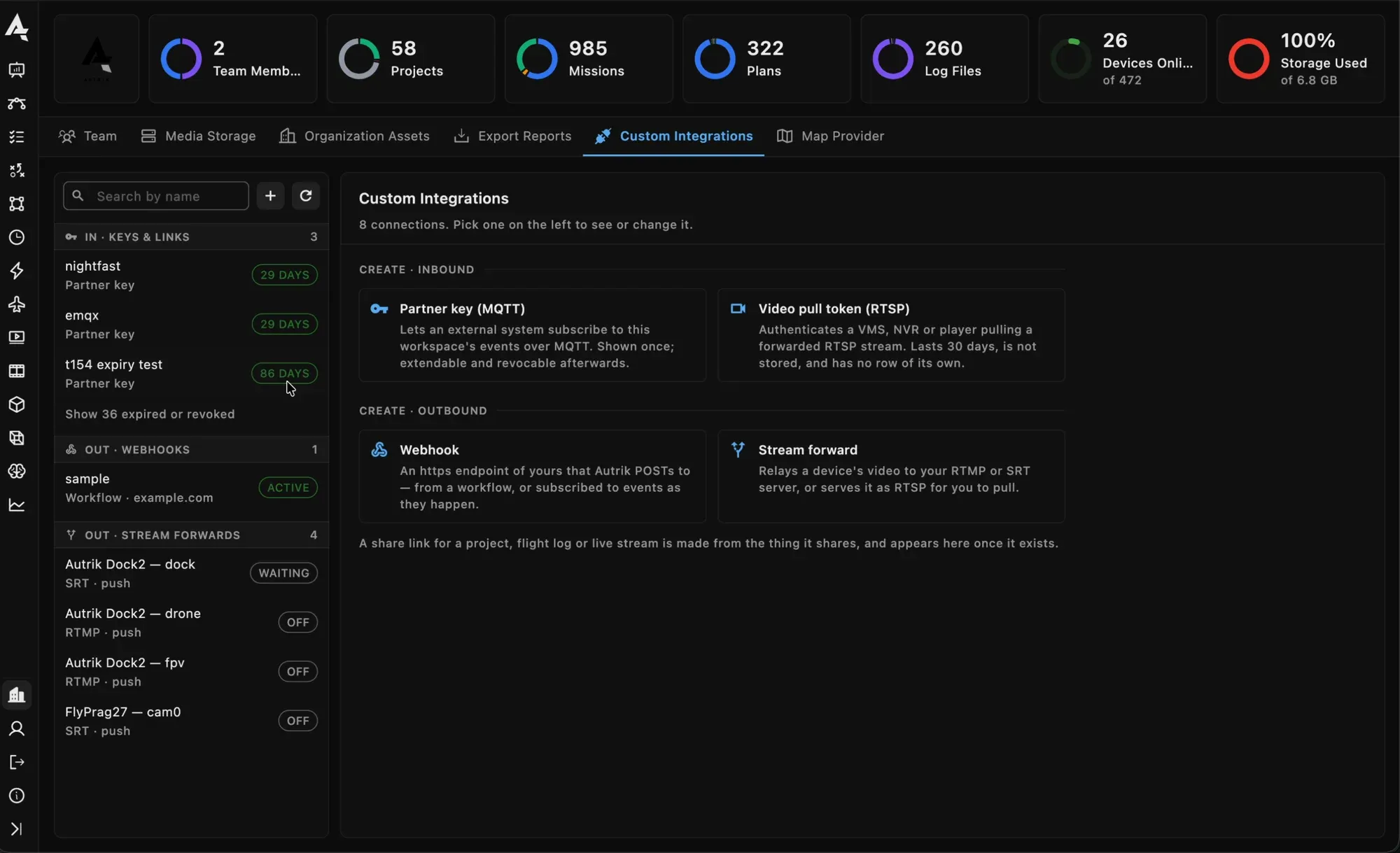
The integrations page: the detector’s alarm arrives as a webhook, the feed goes back out to the VMS.
Integration is the real product
Detections only matter inside one operational picture with response workflows attached. A track from the radar, confirmed by the camera, placed on the map of the site next to the operator’s own aircraft and the geozones, with the response SOP one click away. That is where an operations platform and its integrations earn their place: the detector’s alarm arrives as a webhook, the workflow decides what happens, and the security centre sees it in the system it already watches.
Your own aircraft are part of the answer
A site with a docked aircraft of its own has a verification tool the detector box does not: an alarm-triggered flight that puts a camera on the contact within a minute, records what it saw and returns. The same loop as in drone-verified site security, with the alarm response workflow doing the launching. Which also means your own aircraft have to be the ones your detection layer recognises as friends: the programme includes your fleet, not just the intruders.
Responsible for a site’s airspace and unsure where the box ends and the programme begins? Talk to us.