



· Yogesh Khedar· Engineering· 3 min read
How Drone Light Shows Actually Work
Show swarms are choreography, not intelligence — RTK positioning, pre-planned trajectories and tight time sync. The same plumbing powers working fleets.
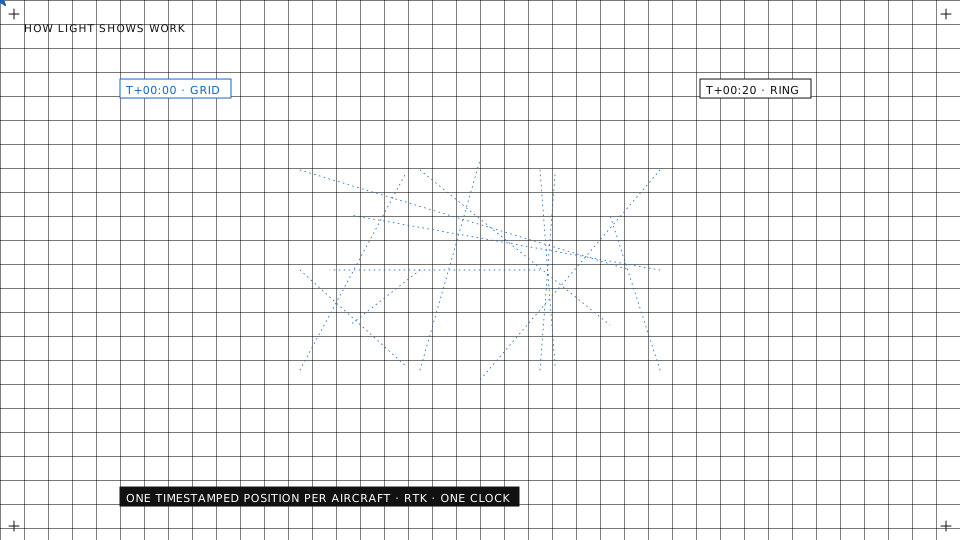
A thousand drones draw a rotating globe over a stadium and the crowd assumes artificial intelligence. The truth is more interesting to an engineer: show swarms are mostly not intelligent at all. They are choreographed, and the choreography is the achievement.
Choreography, not swarm intelligence
Every aircraft flies a pre-planned trajectory, computed offline and checked for collisions before anyone launches. In the air the aircraft mainly do two things exceptionally well: know exactly where they are, and know exactly what time it is.
Position comes from RTK GNSS, centimetre-grade, with a base station on the field and a correction stream to every aircraft. Time comes from the same satellites, so a thousand clocks agree to a few microseconds. The animation lives in the trajectory generator on the ground; each aircraft carries its own timeline of positions and colours and plays it back against the shared clock. No aircraft knows what its neighbour is doing. It does not have to, because the neighbour’s path was deconflicted on a computer the night before.
The building blocks
- Trajectory generation with deconfliction. The animator’s keyframes become per-aircraft paths with a minimum spacing, a maximum speed and acceleration the airframe can follow, and a check that no two paths come closer than the margin at any moment. This is an optimisation problem, and the margin is what a gust can eat.
- RTK infrastructure. A base station, a correction link, and a take-off grid surveyed so each aircraft starts where its timeline says it starts.
- A fleet link, not a piloting link. The ground station uploads timelines, sends the start command and watches health. It does not steer anything. The link is sized for a thousand small reports, not a thousand video streams.
- LED payloads mapped to the timeline, which is the easy part.
- Ground control that treats the fleet as one system, with per-aircraft health on one screen: battery, position error, link, and whether it is where its timeline says it should be.
When it goes wrong
Professional shows are defined by their failure handling, not by the pictures.
A geofenced volume no aircraft may leave, enforced on board, with a land command if it is crossed. Scripted dropout behaviour: an aircraft that loses the link or its position fix dims its light, holds or descends, so a failure disappears from the picture instead of flying through it. Spare aircraft slotted into vacant trajectories before the show, and a pre-flight that checks every one of a thousand batteries, because the one that was not checked is the one that lands in the crowd.
The audience never notices, which is the point.
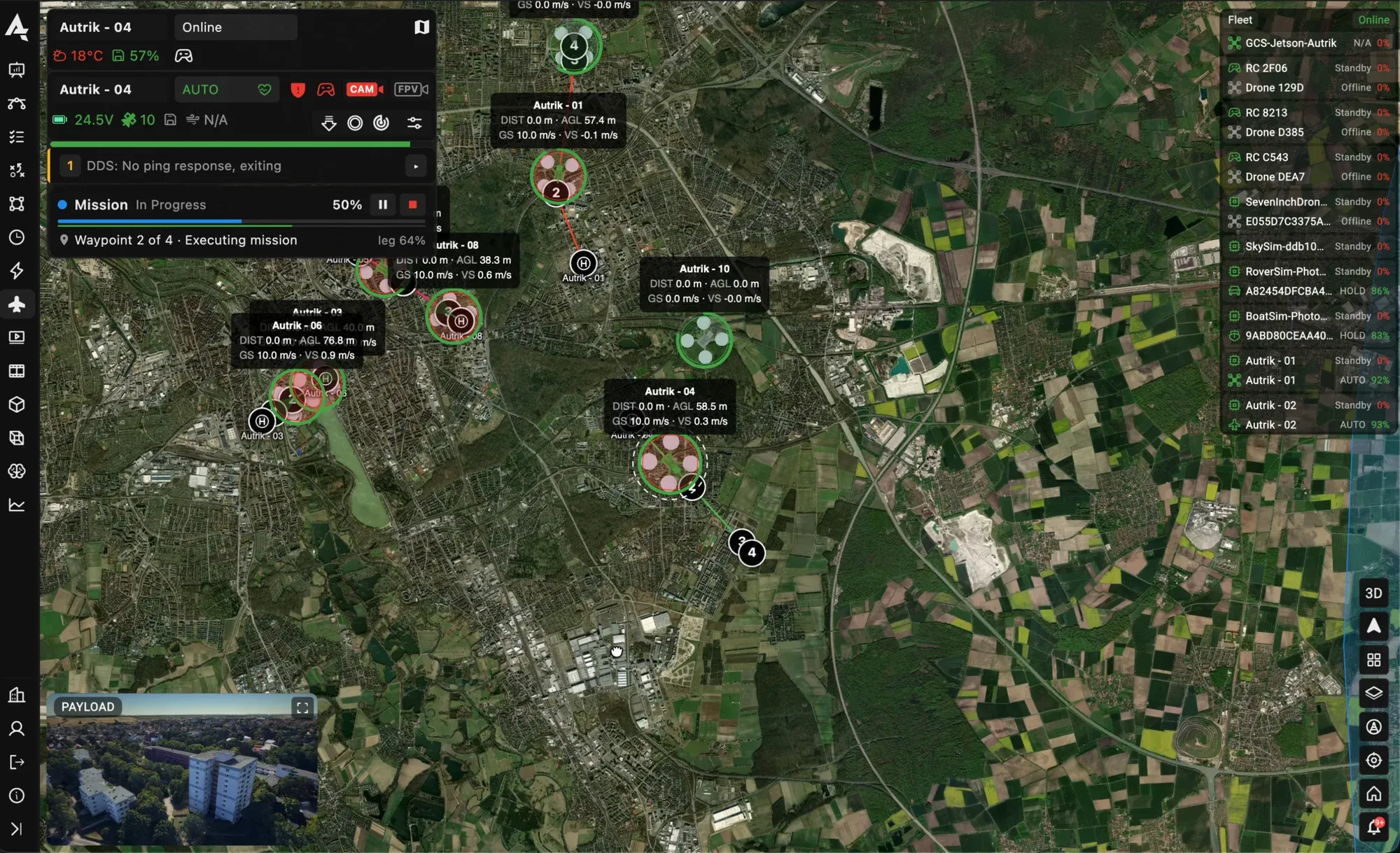
A fleet on one map in the console, each aircraft with its status.
The same plumbing does real work
Strip the LEDs and what remains is fleet management, trajectory planning, multi-vehicle monitoring and simulation-first rehearsal. That is exactly what multi-drone operations need for inspection, security and search, with one difference: the work fleet’s aircraft do react to what they see, which is where the hard part begins.
In AutrikOS the plumbing is the same for both: a fleet of aircraft on one map, each with its health and link in view, plans uploaded and started from one console, a geozone every aircraft respects, and a simulated fleet to rehearse the whole thing before a battery is charged. Show swarms are the proof that coordination is solvable at scale; we are applying it where the mission matters, including in the swarm challenge.
Curious what a coordinated fleet could do on your site? Talk to us.