



· Yogesh Khedar· Operations· 4 min read
Multi-Drone Operations — What, Why, How
Several aircraft, one mission — coverage, persistence and redundancy, and the operational problems you inherit the moment you fly more than one.
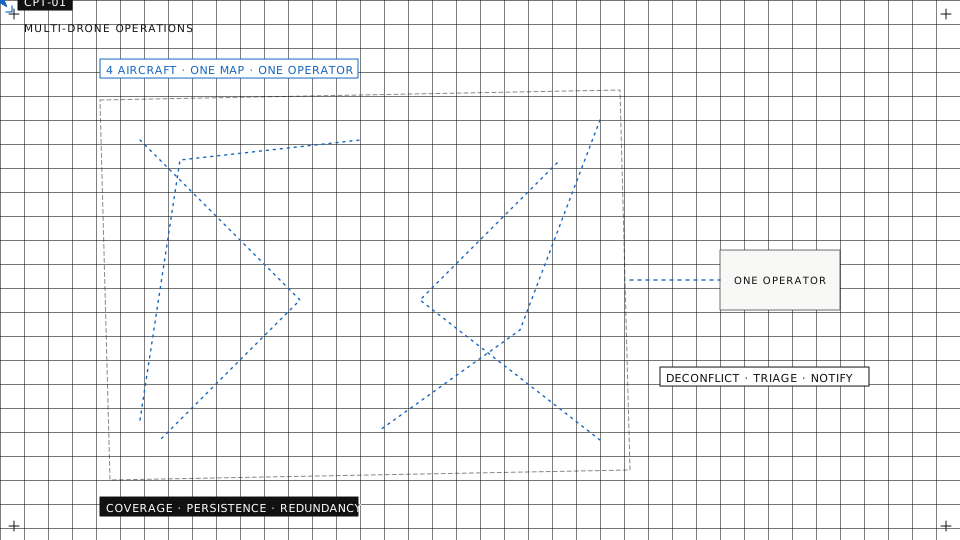
Multi-drone operations means several aircraft flying one mission, or one operator supervising several missions at once. It is where every serious drone programme eventually arrives, and where most of the hard operational problems live.
Why bother
- Coverage. Four aircraft map in one battery window what one maps in four. A survey of a large site becomes a morning instead of a week.
- Persistence. Leapfrog or relay patterns keep eyes on a target continuously while individual aircraft cycle to charge. One aircraft gives you twenty-five minutes over the fire; three give you the afternoon.
- Speed. Search and response scale with aircraft in the air, not with pilot headcount. Two aircraft searching a field from opposite ends halve the time to the find.
- Redundancy. One aircraft down no longer means mission over, and a dock with a second aircraft turns a failure into a delay.
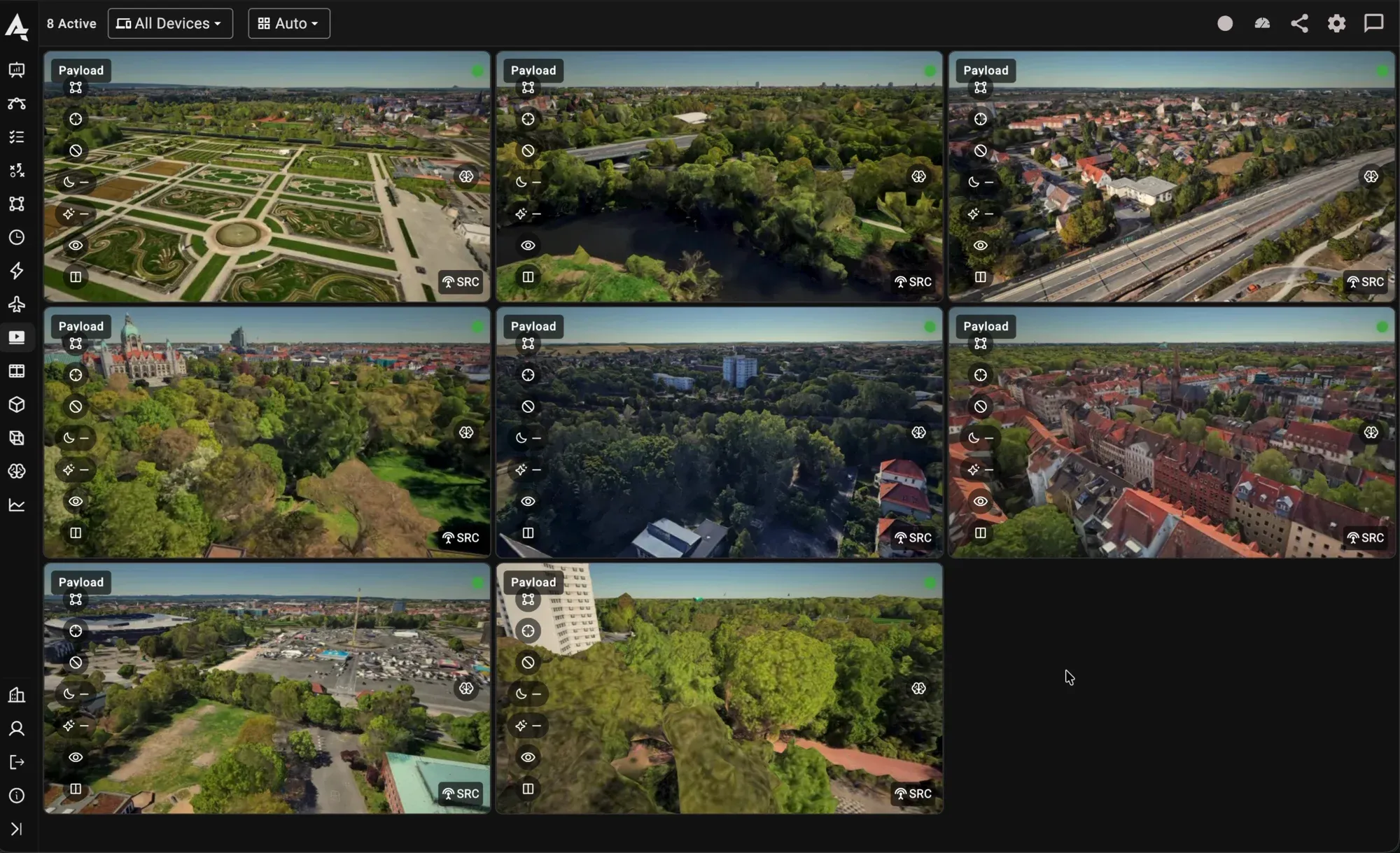
Eight live feeds on one wall.
The hard parts
Airspace deconfliction between your own aircraft. Two survey plans that overlap at the edges, a patrol loop that crosses a search area, a return-to-home path that cuts through a mission in progress. Deconfliction has to happen at planning time, with geozones and altitudes, and again live, with every aircraft’s position on one map.
Link capacity. Several video streams share the same mobile network or the same radio. The stream everyone is watching has to survive; the stream nobody is watching has to step down. Bandwidth is budgeted per stream on the aircraft, and the console asks for a small picture for a thumbnail and a large one for the feed in focus.
Operator workload. Attention does not scale linearly, so the software has to triage: the alert that interrupts, the warning that waits, the event that goes to the log. An operator watching four feeds and twelve telemetry panels sees nothing.
Regulation. One-pilot-many-aircraft approvals exist but must be earned with procedures and evidence: the SOP that says what the pilot does when two aircraft need attention at once, and the records that show it was followed.
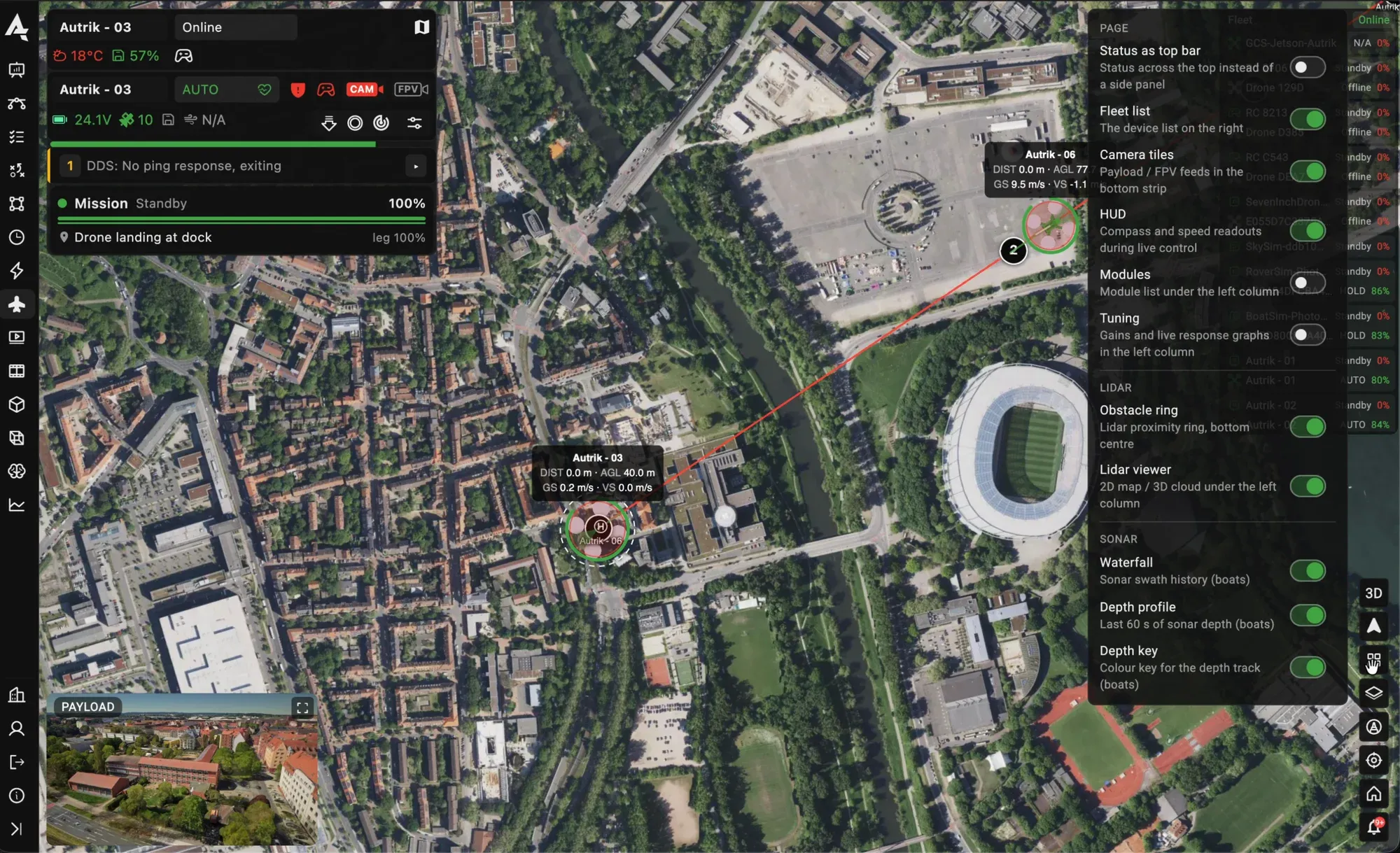
The fly page’s settings panel: each operator chooses the panels in front of them.
The software it takes
A shared operational picture where every aircraft, its route, its camera footprint, every finding and every geozone lives on one map, and every live feed sits on one wall. Per-vehicle health that is glanceable: a chip on the aircraft’s card that says whether it is fit to continue, not a telemetry stream to read. Alerts with levels, so the operator is interrupted only when something needs a human.
That is the design brief for the remote operations centre in AutrikOS: the fleet on the map, the feeds on the wall, the live health chip per aircraft, and the page settings that let each operator decide which panels they want in front of them. With docked fleets the pilot-per-launch constraint goes away too: the dock launches and lands, the operator supervises.
How a team gets there
One aircraft, flown well, with every flight logged. Then a second aircraft on the same console, flying the same plans, so the team learns what two aircraft do to the operator’s attention before a third arrives. Then the dock, the schedule and the alarm trigger, each of which removes one person from one task. The mistake is to buy the fleet first and discover the operation afterwards, which is why fleets are still the exception.
The extreme case
Swarms, dozens to hundreds of aircraft, are the same problems at a density where they must be solved by construction. How show swarms manage it is a story of its own: How Drone Light Shows Actually Work, and why we are competing in the swarm challenge.
Planning the jump from one aircraft to several? Talk to us.